Tag: Assinments

  • Final Project for Photography

    Final Project for Photography

    This is Photoshop project I had to take 3 pictures and a scan of a 3D object.  You might recognise the object, If you’re old enough.  It started out as an homage to one of my favorite 80’s Sci Fi movies, “They Live”.  The project kind of went south when I realized I could not use any words in the project.  If you have seen “They Live” you know what I am talking about, if not watch it.  The movie is a Metaphor for so many things in our society today.  From companies controlling how we live from day to day and how we blindly follow those we don’t really know.


  • Harlem, Watts, Newark and Chicago in the 60’S

           toga hose

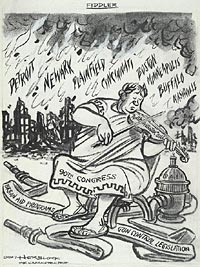
                 In the political cartoon the Fiddler, by Herbert Block we see a man dressed as a Roman senator playing a fiddle, while the cities behind him are burning.  These are the cities that where riots of the 60’s happened.  In this paper, we will be discussing the causes that lead to the most prominent four race riots, and what President Lyndon B. Johnson did to stop these from happening again.

    To give some perspective in 1967 7.8% of white families were living below the poverty line compared to 29.1% of black families, says Robert Dallek in his book Flawed Giant (411).  This means that for every one white person living below the poverty line there were four black people approximately.  We could only imagine what the it was like back then.  In the south whites are still segregating.  I the north things were changing but slowly.

    .  From 1964 to 1967 the summers in the United States cities were destructive and deadly. There were four major riots in this time: Harlem in 1964, Watts in 1965, an in 1967 we had two Newark, New Jersey and Detroit, Michigan; per Joseph Boskin, an Associate Professor of History at the University of Southern California in his book Urban Racial Violence of the Twentieth Century (94).  Each disturbance was started by different trigger points. In Harlem, New York it was the shooting of a fifteen-year-old by an off duty white police officer per a Newsweek issue in 1964 (Boskin 100). This borough of New York is where many black people were pushed into living by the white upper class.  In fact most of the contact with white people were the police, shopkeepers and bill collectors.  The living conditions and the jobs situation were not all that promising.

    In Watts a section of Los Angeles, California it was a “traffic arrest, where a white officer struck a protesting black bystander with his club.” As described in Alan Brinkley (707).   Just like in Harlem the living and working situations were rough and the primary contact with white people were the police.  In fact there were two reports done on the Watts situation. The first one was the Moynihan Report and the other the McCone report.  These reports were different in that they took a more sympathetic look at what was going on, instead of just the statistics.  They described the living situation and the employment opportunities, but did little to suggest what could be done (Baskin, 109).

    The start of the Newark, New Jersey riot was far more complex.  Like the previous two there was an underlying tension between the police and the black community.  The more prominent issues though were lack of education and an high unemployment rate (Boskin, 118).  The city was running out of money and the Mayor nominated an undereducated white man to head the Board of Education in the Newark.  When the African American were pushing for an African American man with a master’s degree, and had worked for the budget office (Boskin, 119).  In the end was a rumor about a black cab driver named John Smith (Boskin, 120) whom people saw being dragged into the police station that kicked things off.  There was a civil rights leader and two militants that tried to quell the growing crowd by trying to turn them in to a peaceful protest. When rocks were thrown in to the crowd and hit many of the people and broke a few police car windows. This was just the beginning of a chaotic couple of days filled with miscommunication between the National guard, State and local police, looting and gun fire (Roskins, 124).  Yet, this was nothing compared to what was to come in Detroit.

    Detroit was one of the last places that had the riots, this might be because of the previous race riot back in 1943.  It was also the worst of the riots. The disturbance in Detroit was started by an early morning raid on a speak easy a few weeks after the Newark riots.  The Detroit riots was the worst of these disturbances causing “40 deaths, 2,250 injuries, 4,000 arrests, $250 million in property losses” in a week (Boskin, 127).  President Johnson was reluctant to send in help at first, (Dallek, 413) He was afraid of the political repercussions and did not want the Republicans to try and take advantage of the situation.  Eventually Johnson had no choice, but to send troops in, after the Governor of Michigan was not able to handle the situation (Boskin, 128).  Johnson was now fighting what seemed to be two wars now.  Looking at the images of what was going on in Detroit back then, on Bill Moyers Journal: Race and Politics in American Cities, it looked far more like a war zone than a Prospering city.

    The first idea he had was the National Day of Prayer.  Next Johnson started riot training for the National Guard for The last of the key ideas that Johnson put into action was a bi partisan report on what caused the riots and how can we stop them from happening again.  This was known as the Kerner Commission report. According to former Senator from Oklahoma, Fred Harris, one of the last remaining members of the commission, Johnson thought that there was some kind of conspiracy because of the riots (Bill).  During the investigation they found that in some areas in the north like Milwaukee, Wisconsin that the segregation was so pervasive that most black people did not see white people at all (Bill).

    In this Essay we talked about the causes of the 4 Main riots of the 1960’s.  We talked about the living and working conditions that were in place that caused these uprisings.  We also discussed what President Johnson did to try to make sure these types of events do not happen again.  At least not in his life time.


    Works Cited

    Bill Moyers Journal: Race and Politics in America’s Cities. Films Media Group, 2008,

    fod.infobase.com/PortalPlaylists.aspx?wID=100853&xtid=39434. Accessed 19 Apr 2017.

    Boskin, Joseph. Urban Racial Violence in the Twentieth Century. Beverly Hills [Calif.]: Glencoe

    Press, 1969.

    Block, Herbert L. “Fiddler.” Library of Congress: Prints and Photography Division, The

    Washington Post, 2001, http://www.loc.gov/pictures/item/00652231/. July 25, 1967.

    Brinkley, Alan, John M. Giggie, and Andrew J. Hubert. The unfinished nation: a concise

          history of the American people. New York, NY: McGraw-Hill, 2016. Print.

    Dallek, Robert. Flawed Giant: Lyndon Johnson and His Times, 1961-1973. New York: Oxford

    University Press, 1998.


  • Analysis of Narrative of the Life of Fredrick Douglass, an American Slave and Incidents of a Slave Girl by Linda Brent

    Warning this post has terminology in it that maybe offensive to the reader.  I have recently realized myself that, there is one word in particular that tears me up inside just to hear it spoken in common tongue.  It was after reading these two stories that I realized how dirty and disgusting one word can make you feel.

    I was assigned Narrative of the Life of Fredrick Douglass, an American Slave and Incidents of a Slave Girl.  Through these two Narratives I have learned a lot about the conditions and trials of the African American and were forced to work for little or nothing.  To me these stories were heart wrenching and at the same time give me hope in the chaotic times in which we live today.

    Mr. Fredrick Douglass and Ms. Linda Brent, I use Mr. and Ms. out of respect for these two courageous souls and their trials, were born into slavery and raised by their grandmothers.  They also barely knew their mothers, but for different reasons.  Mr. Douglass’s mother was sold to another slave holder when he an infant.  Whereas, Ms. Brent’s mother died when she was six years old.   Mr. Douglass did not know who his father was.  There were rumors that his master was his father, yet no one knew for sure.  Ms. Brent knew she was mulatttoe, because her grandmother had “Anglo-Saxon” blood in her. These were the times that were horrible for the black man and even worse for the black women.  Yes, the men were whipped and beaten, but these wounds were only physical.  The women on the other hand were raped, molested and were thought to be less valuable then the men, who worked in the fields.  Ms. Brent was lucky in that respect; she was not raped.  Although, she was constantly harassed and advanced upon by her second owner a Dr. Flint, when she was in her teens.

    Ms. Brent knew her father he was a free black man, who was a skilled trades man and made money of his own, which was unusual.  When Mr. Douglass started learning calk in the ship yard, had to give all the money he earned at first to Master Hugh, in Baltimore.   Most and was trying to earn enough to buy his families freedom, but with no such luck.  For the better part of her childhood she did not know she was a slave.  She was taught how to read and write by her first mistress from age six; until she died when Ms. Brent was twelve.  This was when she first realized her life was not really her own and was sent to her mistress’s sisters, whose husband was Dr. Flint.  Mr. Douglass on the other hand did not have the luxury of learning how to read and write till he was sent to Baltimore.  Then when his new mistress, who had been from the north, tried to teach him was stopped by her husband Mr. Auld.  Mr. Auld, who fore bade her from instructing him any further said; “A nigger should know nothing but to obey his master-to do as he is told to do.” To summarize the rest that if you educated a person that they would be miserable and may rise up against his slave holder.  This did not stop Mr. Douglass though, he came up with an ingenious plan, I think, and tricked the kids on the street to teach him how to read and write.  He did this by telling him he already knew how to read and write, then when he did not get it write they would show him, not knowing that they were teaching him.

    Mr. Douglass was raised in Maryland where was thought that they treated their slaves better than below the Mason-Dixon line.  Through my reading these narrative, I saw very little difference between the two myself.  Ms. Brent Being from South Carolina saw many of the same things going on, as Mr. Douglass.  Although, I remember a particular scene in which she described a man being strung up by his chest and having hot lard dripped on him for disobeying his slave holder.  I read this and cringed at the thought.  How could people be so cruel to another?  Later we find out that Ms. Brent passed on her knowledge to an older slave who wanted to know how to read the bible, so he could be closer to God.

    Another thing they both witnessed in their lives is when their slave holders found god they, became even more cruel to their slave.  The slave holders could find justifications for their treatment of slaves in the bible and strengthened by their religious leaders.  Mr. Douglass said: “my master attended a Methodist camp meeting held by the Bay-side, Talbot county and experienced religion…” and continued “It neither made him to be humane to his slaves, nor to emancipate them.”  Which he hoped for so dearly it would.   Ms. Brent described a similar experience with Dr. Flint.  When he found religion is when he stared to be crueler to her and hit her on a couple other occasions.  This is something he did not do but once before.

    Dr. Flint did not rape Ms. Brent, but this did not stop his unwanted advances toward her.  Not only did she not want these advances, this also made his wife jealous of her and whenever Mrs. Flint could she would try and make Ms. Brent’s life miserable.  Dr. Flint was obsessed with Ms. Brent to the point where she would try anything to make him not want to have anything to do with her.  To this point she ended up having two children with a man she didn’t love, but whom treated her decent.  These attempts did not stop his advances to the contrary, these two children gave him leverage over her.   In order to save her children, she planned her escape hoping that if she ran, he would sell them.  Now, I know this sound bad, but the father of the children was ready to purchase them from Dr. Flint.  Though it took quite a while, but eventually Dr. Flint did sell them to a slave trader who unbeknownst to him was sympathetic to Ms. Brent and her family.  Dr. Flint did not want to sell them, but because of his obsession with her that he barrowed $500 with interest to go find her in New York where he thought she was.  It was this that caused him to be low on money, so he had to sell them.  The person he borrowed the money from was harboring Ms. Brent in the attic of her home.  After reading about this I laughed so hard, for she had finally gotten the better of him in some way.

    Mr. Douglass Had tried to run a way about three times before he finally made it to New York.  There he had no friends and did not know who to trust.  This was until he met a man by the name of Mr. David Ruggles who helped him to secure passage to New Bedford.  Before he left for New Bedford he met a woman who would be his wife Anna.  They traveled together to their new home.  For Ms. Brent her journey to freedom took a long time.  She did not try to escape, but once and it was a long journey.  Hiding at one friends home, then she went to another’s hiding in her attic for quite a while.  The next place she hid was in the crawl space above her grandmothers shed.  In all these situations she had multiple close calls with Dr. Flint.  Eventually she made to Philadelphia and then New York and she was a free woman.


  • Analysis of “Indians of the Rio Grande”and “Jacques Cartier: First Contact with the Indians”

    Through reading these narratives we see through the Eyes of the Spanish, French and the Iroquois.  In the case of Alvar Nunez Cabeza de Vaca, “Indians of the Rio Grande” he talks about How they are as he puts it “They are very merry people”.  Even when they have nothing they still celebrate and dance.  In his journal he talks about the eight months he spent with the Avavares Indians and how they became as medicine men to the tribe.  These people also seem to almost worship Cabeza de Vaca and his men.  With most of the tribes Cabeza de Vaca I feel he saw them as naïve and poor, but grateful and giving.  The same could almost be said with the experiences of Jacques Cartier: First Contact with the Indians.   Though when Cartier first sees the natives he is fearful of their numbers and decides to leave.  After a confrontation the two sides meet on an Island and Iron out their differences through signs and trade.  The native here were basically willing to give Cartier and his men the clothes on their backs for trade.  This was common amongst all the tribes he met.  Another thing he noticed was they were all fisherman.  They lived on the lakes and stream in boats they also loved their ceremonies’ and dancing it seem whenever they met a new tribe.

    In comparison they Native the tribe saw the Europeans as crooked and out of balance in the mind.  As it is said in the Dekanawida Myth &the Achievement of Iroquois Unity “North of the beautiful lake [Ontario] in the land of the Crooked Tongues”, by Crooked Tongues I take that to mean the Europeans, otherwise they would have used the other tribes name.  It is because the Europeans see the Iroquois and other tribes as naïve and gullible that they take advantage of their kindness.  Then when resources start to become scarce and a lust for war starts to break out amongst the tribes that Dekanawida calls the leaders of the Mohawk, Onondaga, Seneca, Oneida, and Cayuga.  This was to stop the tribal wars and confront the Europeans whom they call “Adodarhuh”.  They see them as if they were a broken people and in the Myth they were able to sing and cure the Adodarhuh of their evil ways.  So the European invasion lead to the formation of

  • Document Analysis 2

    This is a comparison and contrast analysis of “The Expulsion from Spain, 1492” and “The Chinese Rites Controversy”.

    While going through the reading this week I noticed that the biggest sources of tension is the merging of religion and government.   As I was reading “The Expulsion from Spain, 1492”it seemed as though the Jewish people were highly persecuted by the Catholics of Spain, Portugal, Fez, Berber and the Genoa’s.  Spain with King Ferdinand who had first banished them from the country and taking over the land that the Jews owned.  This was the time of the Spanish Inquisition in which any person not a Christian was in great peril, due to the torture and being burnt at the stake for being a heathen.

    In Portugal they were fleeced and were allowed to stay there for a few months then forced to leave.  In Fez and Berber, they would not even let them in the cities in Northern Africa, thus many Jews died outside the wall.  The few that escape to the north were robbed and treated horribly by the Genoans, who were more like pirates than anything.  A few of the Jews of the time did find safety in the northern African country of Tlemcem only because it was a Jewish kingdom.  More of the Jews made it to Naples, Italy where the king took them in and helped the refugees out.  Even those who disliked the Jews (The Dominican Brotherhood) took pity on them there.  More of the Jews were taken to Turkey where they were received as artisans.

    In comparison to the Jews, the Christians subject of the sultan could sell their children into slavery.   This was not like the type of slavery The US had through the 19th century.  People did this because they had very little money and it was better than selling them to a lord.  These slaves were educated and armed.  All though they were taught from the Koran instead of the Bible.  Of course during this time period, the Muslims were the best educated.  These slave became some of the Sultans most trust advisors.

    The conflict between the Confusionist of China and the Catholics of the Europe was there conflicting ideologies.  This very apparent in “The Chinese Rites Controversy”.  The early Jesuits told the Emperor of china at the time that if they converted to Christianity that they would be able to practice their own rituals.   Unfortunately, Pope Clement the XI was a bit power hungry and did not want them to practice the rituals.  This lead the Emperor to ban the rhetoric of religion from the country.

    So as you can see Religion played a big rule in the politics of the period.  From the Spanish Inquisition to the Christian slaves in turkey all the way to the early 18th century where Catholic Pope tried to rule over Christian convert four thousand miles away.  We still see these sort of conflicts in today’s society as well.  Though they come in different forms and in different countries.   Will we as the human race ever let go of the negative parts of religion?  I would like to think it is possible.

  • Origin Stories

    This is a short comparison and contrast  analysis of the creation myths of the first couple of pages in the  Iroquois and the Bible (genesis).

    Origin stories are useful for understanding how cultures see themselves in relation to the world around them.  They also help us to see both the commonalities and the differences between them.  Look at the Iroquois origin story Judging by the imagery we can tell that they worship a natural based religion.  With the ducks and the monsters of the deep try and save her, then we have the great turtle which represents earth when she “planted bits of roots and plants she brought from the sky.”  We see the same naturalistic in the Yoruba creation story, using imagery like the marshes and snails to create the Earth.  One of the biggest things we see in these two stories is the cycle of life.  In both stories we have images of bodies decomposing and creating new life.  This shows how respectful and knowledgeable they were about the natural order of things.

    In the Yoruba story the coveting of knowledge as Olorun puts Orisha Nla to sleep so he could hide the knowledge of life.  In genesis we see the same thing in Gen 2:16 “Of every tree of the garden thou mayest freely eat.”  2:17 “But of the tree of the knowledge of good and evil, thou shalt not eat of it: for in the day that thou eatest thou shalt surely die.”  Here we see the same the god covets knowledge, hiding the knowledge from its creation.  This I feel shows how they saw knowledge even back then, as power.  The more you know about something the more you have control over it.

    Vengeance is a common theme which throughout religion and its texts.  Taking another look at Genesis we see how vengeful god can be in chapter 3:13 to 3:24. In this chapter we see him curse the snake, Eve and Adam.  The snake was cursed to live among the cattle and eat dirt.  All three were cast out of Eden. But, eve got the worst of it with the curse of child birth and forced to live under the control of her husband.  In the Iroquois myth at the end the right handed brother thought his grandmother favored the left handed brother after he killed him.  So, the right handed brother chopped off her head and through it in to the Ocean.

    These are just a few of the similarities and differences I have seen through the readings.  No matter how different the religions are in some ways there will always be commonalities in others.


  • Demographic News Viewing Poll

    In my U.S. Politics class we are separating into groups and doing a poll on the Demographics of News viewing habits.  I am asking if any one would like to participate in the poll.  It is confidential and only 14 questions and it should only take 5 Minutes.  You must be 18 to take this poll.  To take the poll click here.

    Thank you for the help.

  • My goal

    This is my Final paper for Prep. for English comp. class

    The Peace Corps

    To put a new spin on a quote from John F. Kennedy: “Ask not what [our world] can do for you, but what you can do for [our world]” (Kennedy).  As I see it, we are not citizens of individual countries. We are citizens of the world as a whole.  My goal is to join the Peace Corps and help those who do not have the education and resources I have been privileged to have. The reason for me joining the Peace Corps are many and varied. The things I will have to do in order to achieve this goal are getting a degree, volunteering, and learning another language

    There are a few reasons I want to join the Peace Corps.  One reason is I want to help people who need it and share my skills with them. I want to be able to give people hope in what might seem to be a hopeless situation. I want to experience other cultures and to travel to places where no one would think to go.  I would like to build bridges between the people of this world.  An additional benefit to the reasons above is it looks good on a resume. It shows you are not afraid of taking chances and thinking outside the box.  Ultimately, I want to bring a sense of meaning to my life.  Therefore, these are just a few reasons I want to join the Peace Corps.

    What will I need to do to join the Peace Corps?  Well, let’s check the basics: I am at least 18 and I am willing to commit to 2 years (“Peace Corps”) to helping others, check. Those are the 2 basic requirements.  Now, to help me be more valuable as a volunteer, I am going to need a degree.   I am currently working on a BA in Social Studies Education. The reason I chose social studies is the fact that I like history, learning about other cultures, and trying to understand how society works.  The education part is that I want to help others to understand society, so we can make this a better place for us all.  I know I dream big.  Do I need a degree? No.  Does it help? Yes.  Most of the openings prefer people with a degree in something, depending on the focus of the program or project.  Working on this degree will help me with another thing they look for, which is volunteering in the community.

    Now, volunteering is not something I am used to, at least not charity work to be honest.  My family has never really volunteered with humans except by donating food, clothes, or toys.  Through my research, I found many Vlogs (video logs) done by Peace Corps volunteers.  One of them said that “volunteering is not for everyone…this is an extreme version… giving up your life and what you want to do in order to do something for someone else”(Thinking).  I am willing to volunteer here at home to ready myself for this endeavor.  I am looking into Big Brothers Big Sisters where I can get used to working with kids one on one.  This will help me to be a better teacher and mentor in the future.  This can also be a confidence builder for me and a challenge.  Being a volunteer has many perks that go with it.   The most important is the feeling of accomplishment from doing something I have not tried before and sharing that with someone else.

    In addition, I need to get some language training.  I know a few words in other languages, but I cannot read or write one.  The Peace Corps doesn’t require that you know a language. However, it would help me tremendously just to get the practice, so when they train me for my host country’s language, I will be ready (Thinking).  I am thinking either French or Chinese. I am thinking French because there have been many countries around the world that were colonized by them and they still speak a version of it.  Chinese is a consideration for the simple reason I have always been fascinated with their culture and their growing economy.  French and Chinese are two languages that could not be more different, yet have a lot of sway in this world.  This is what makes it such a hard decision.

    There are many things I need to do to get ready for this challenge, from my education, to testing myself as a volunteer, and learning a language.  I know I can do this.   In the end, I want to know that I have made a difference in people’s lives and helped build a better world for tomorrow.

    Work Cited

    Kennedy, John F.  Inaugural Address, January 20, 1961, Washington D.C.         www.ushistory.org/documents/ask-not.htm 1/12/2015

    “Peace Corps Volunteers” Peace Corps Updated Sep. 02, 2015 Web. 18/11/2015.

    www.peacecorps.gov/volunteer/learn/.

    Thinking About Joining Peace Corps? Part 1, You Tube Rickenberger, Bryce        September      13, 2013 youtu.be/LVOELMxGqis Web. 1/12/2015